
Stainless steel is widely used in modern watchmaking, but not all alloys perform the same.
In watches, the most common materials are 316L and 904L stainless steel.
While these two alloys are often compared as if one were universally better, the reality is more nuanced. Their differences lie mainly in corrosion resistance, finishing characteristics, and manufacturing requirements.
Which steel is “better” depends on how the watch is used, how it is made, and what qualities the manufacturer prioritizes, rather than on a simple hierarchy.
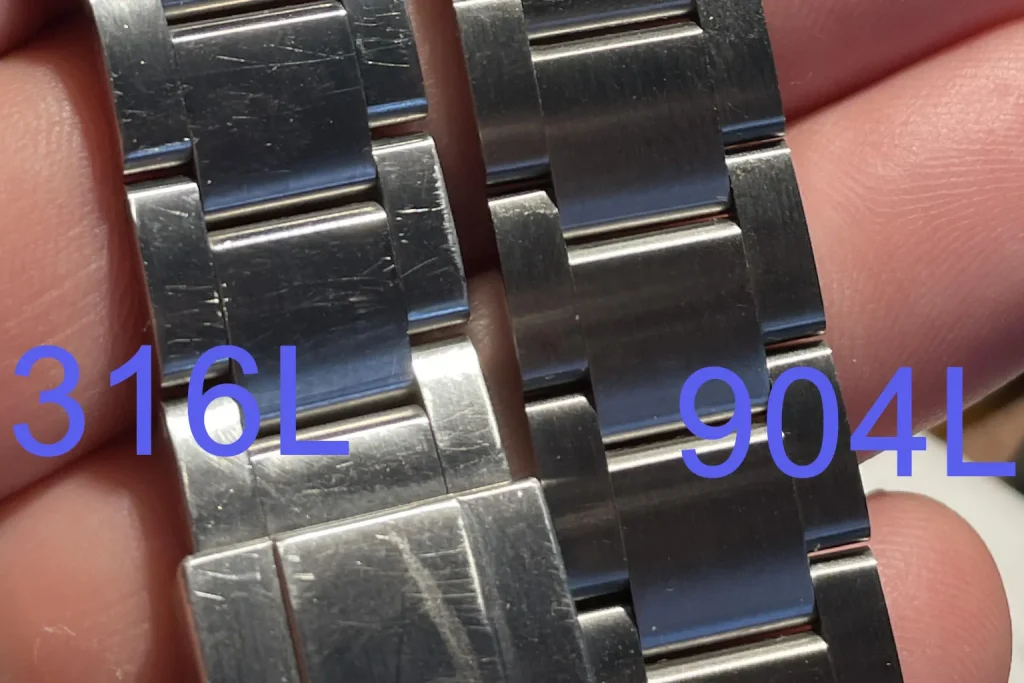
What Is 316L Stainless Steel?
316L stainless steel has long been considered the industry standard in watchmaking.
It is a low-carbon alloy containing chromium, nickel, and molybdenum, offering a balanced combination of corrosion resistance, durability, and machinability. Because of this balance, 316L has been widely adopted across a broad range of watches, from entry-level models to high-end timepieces.
Key Characteristics of 316L
- Good corrosion resistance in everyday environments
- High structural stability for regular wear
- Relatively easy to machine and finish
- More efficient production compared to specialized alloys
For most daily use cases, 316L stainless steel performs reliably and consistently.
What Is 904L Stainless Steel?
904L stainless steel is a more specialized alloy originally developed for demanding industrial applications where resistance to acids and corrosion is critical.
Compared to 316L, 904L contains higher levels of chromium and nickel, along with additional copper. This composition enhances resistance to corrosion and oxidation, particularly in environments involving prolonged exposure to moisture or perspiration.
Key Characteristics of 904L
- Enhanced resistance to corrosion and pitting
- Greater stability in humid or high-sweat conditions
- A denser surface appearance when polished
- More complex machining requirements
Because of these characteristics, 904L is less commonly used and typically requires more advanced manufacturing processes.
Corrosion Resistance: Practical Differences in Daily Wear
One of the most meaningful differences between 316L and 904L stainless steel lies in corrosion resistance.
- 316L performs well under typical daily conditions, including occasional exposure to moisture or sweat.
- 904L offers additional resistance in more demanding environments, such as frequent wear in warm climates, high humidity, or regular contact with perspiration.
For many wearers, this difference may not be immediately noticeable. However, over extended periods of frequent use, enhanced corrosion resistance can contribute to improved long-term surface stability.
Finishing and Surface Appearance
Another area where differences may become apparent is finishing.
- 316L stainless steel achieves a clean, consistent finish and responds predictably to brushing and polishing techniques.
- 904L stainless steel tends to develop a slightly richer, denser sheen when polished, particularly on high-polish surfaces such as case flanks, bracelet center links, and bezel edges.
These visual differences are subtle and depend heavily on finishing quality rather than alloy choice alone.
Manufacturing Complexity and Cost Considerations
904L stainless steel is more challenging to work with than 316L.
- It places greater stress on cutting tools
- Requires slower machining speeds
- Demands tighter process control during finishing
As a result, producing watch cases and bracelets from 904L generally involves higher manufacturing costs and longer production times. This practical consideration is one reason many manufacturers continue to rely on 316L, even in premium segments.
316L vs. 904L: A Balanced Comparison
| Feature | 316L Stainless Steel | 904L Stainless Steel |
|---|---|---|
| Corrosion Resistance | Very good | Excellent |
| Surface Finish | Clean and consistent | Slightly denser polished appearance |
| Durability | High | High |
| Machining Difficulty | Moderate | Higher |
| Production Cost | Lower | Higher |
| Typical Use | Industry standard | Specialized or premium applications |
Our Material Selection Approach
Most of our watches are made using 904L stainless steel, while a small number of models use 316L stainless steel depending on design, structural requirements, and intended use.
This material selection is based on performance considerations rather than marketing labels, with corrosion resistance, finishing stability, and long-term wear behavior as key factors. In cases where 316L provides appropriate performance and design advantages, it remains a practical and reliable choice.
Is 904L Always the Better Choice?
Not necessarily.
316L stainless steel remains a highly capable material and continues to perform well in a wide range of real-world conditions. In many cases, the differences between 316L and 904L may be subtle and influenced more by manufacturing quality than alloy composition alone.
Material choice should be evaluated alongside design, finishing, and usage expectations rather than viewed in isolation.
Final Thoughts
The difference between 316L and 904L stainless steel is not about right or wrong—it is about application, environment, and intent.
316L offers proven reliability and manufacturing efficiency.
904L provides enhanced corrosion resistance and a distinctive finish, with added complexity in production.
Understanding these differences allows for a more informed evaluation of a watch—not based solely on specifications, but on how materials are selected and applied in practice.